By Fiona C.
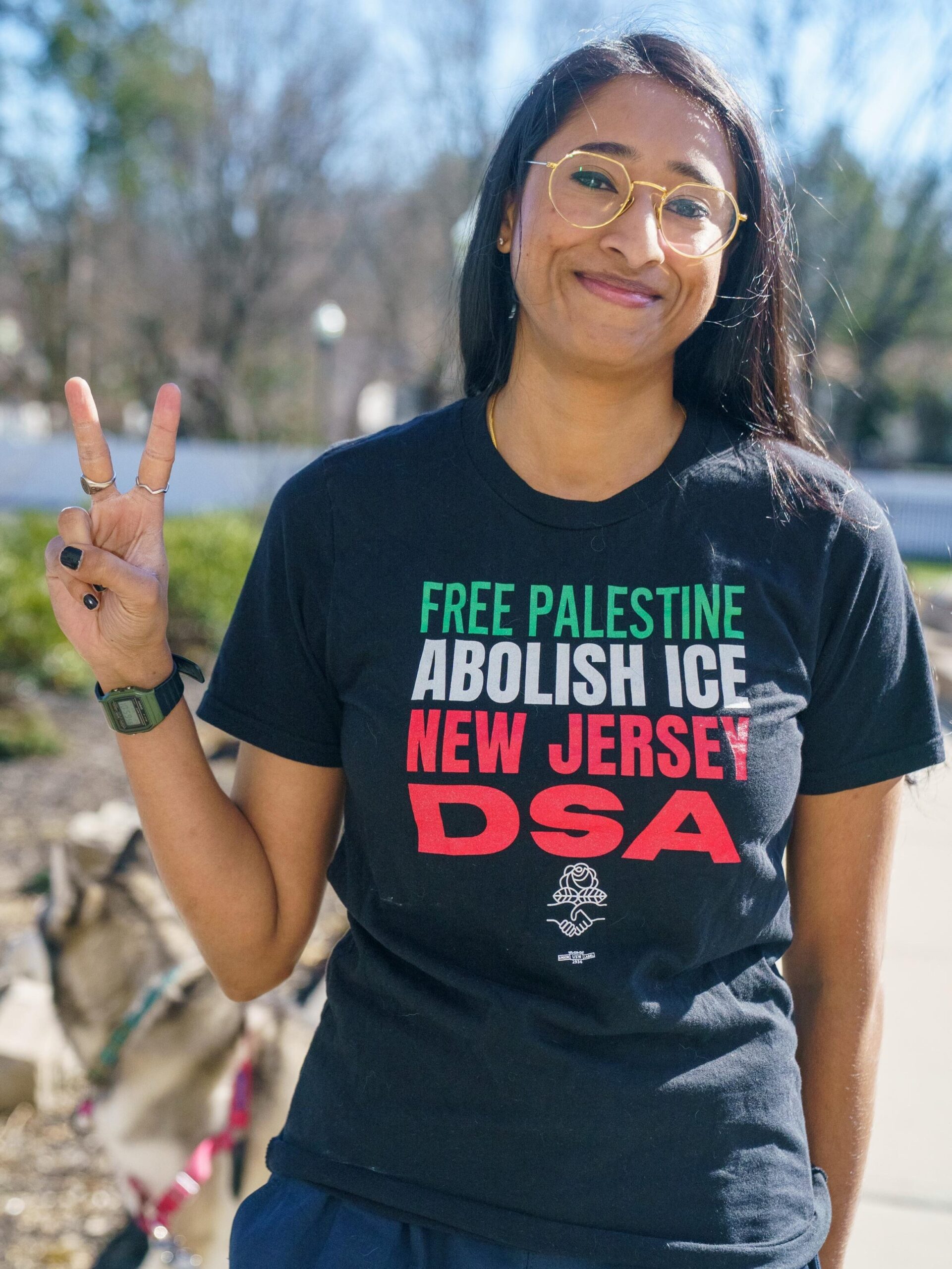
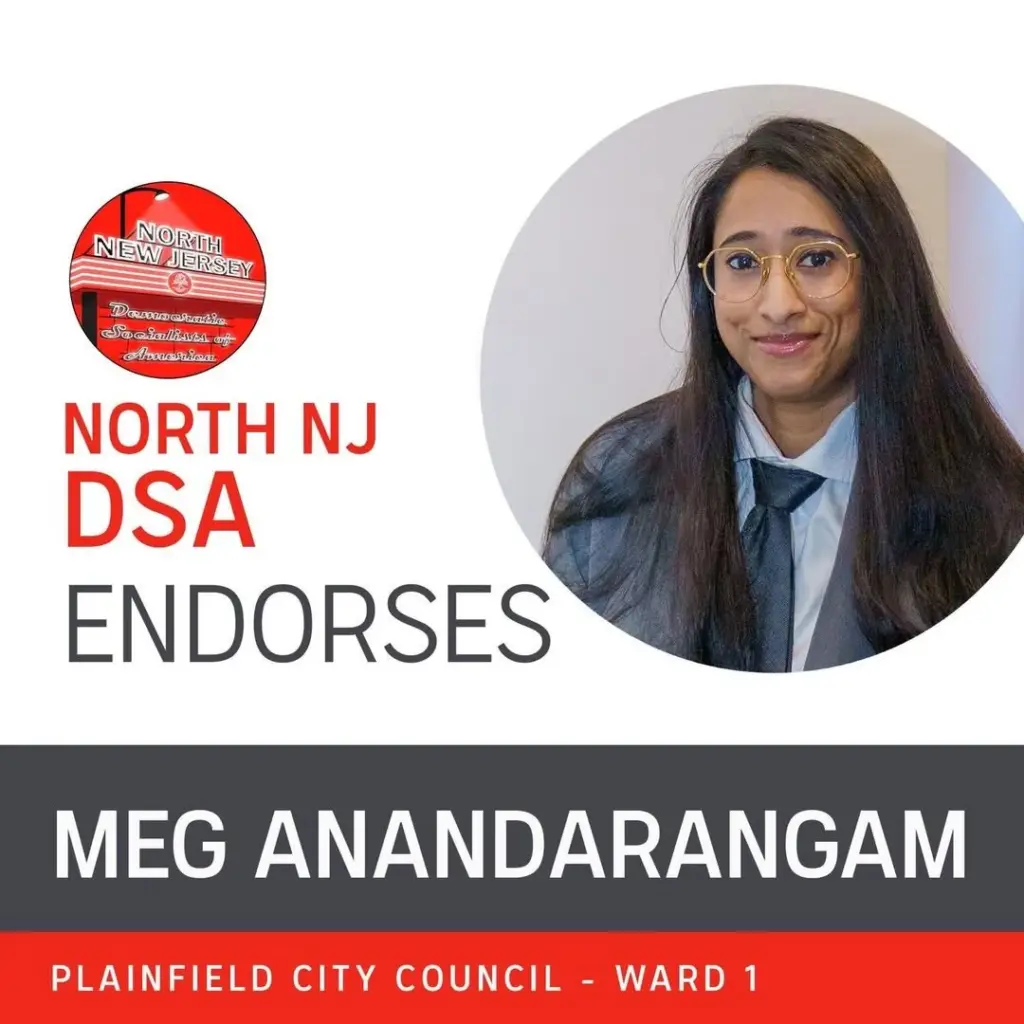
Updated as of June 11, 2026: Meg Anandarangam is a NNJ DSA-endorsed candidate who recently ran for City Council in Plainfield, Union County. Meg is also co-chair of Union County DSA. Garden State Socialist had the opportunity to interview Meg about how she got into organizing, as well as her hopes for the “Queen City.” Although Meg was not elected to office, every Democratic Socialist on the ballot is a win and these experiences help us prepare for future electoral efforts.
Following the election results, Meg shared this statement:
“I am glad to have gotten some much needed rest and can’t wait to get back to focusing on the work that I love and am passionate about. I am happy that I can return to that work with my head held high and more capacity to assist in any way possible. Thank you for your love and support. I hope that at least my campaign has sparked an interest in people asking for more from their electeds and paying attention to who they really work for. We must continue with a sense of revolutionary optimism, so I am not deterred in the slightest. Next battle is rent control.”
Read on for our full pre-election interview with Meg A.
What compelled you to run for Plainfield City Council?
The reason I decided to run is I looked around and I saw leadership that wasn’t really representative of the Plainfield working class. I looked around and saw our Hispanic community is not being cared for — not in how laws are written, not in how public services are distributed, not in who we choose to protect, and that has to change. Oftentimes here in Plainfield, it’s the same handful of people making all of the decisions. Oftentimes they’re running unopposed. And I didn’t see that opposition coming from anywhere, so I decided to run. I feel like leadership in general is rooted in the working class, it should be people leading who understand these struggles firsthand, and not those making insider decisions under such a lack of scrutiny.
That being said, what will be your biggest priorities on the council?
My big three platform points are rent control & code enforcement, people-first development, and real public services. Rent control is not unheard of in Plainfield; it was proposed during the previous election cycle. It was well received. The mayor ran on it, a council member was using that as well. But post election, it’s never heard of again. I think Plainfield is being taken advantage of by large corporate developers who rely on a lack of rent control and code enforcement. These buildings will get to such a state of decay, where people are given 24 hours to vacate the premises, given no other resources or assistance, and then the building is sold to a large corporate developer and suddenly it’s $2,100 for a studio. It prices everyone out.
And then real public services. It’s kind of the basics, making sure potholes are filled, that trash collection is done at a reasonable time in the areas that need it, that — and this might be going back to code enforcement again — if you have an apartment building and it has, say, 40 units, one dumpster is not really going to do it. It’s about holding these landlords accountable, and holding the property owners accountable when they’re trying to cut corners.
Which of those in your mind will be the biggest challenge to accomplish?
I think that it’s going to be the people-first development. Going back to my priorities for Plainfield, I want a sanctuary city. I want increased government transparency, and I want increased civic engagement. I think the current administration takes advantage of the fact no one is paying attention and is unengaged. They receive little to no pushback whatsoever. Decisions are able to be made unquestioned, and are not easily available or relayed in a coherent way to the public. That allows for things to progress unchecked and large corporate developers are able to capitalize on this.
People-first development should be the standard. We should be building our city around what people actually need, not what developers want. Developers are always going to push for what’s more profitable, right? Like luxury apartments, higher rents, but — that makes our communities a lot more expensive, inaccessible, and overall less reflective of the people who actually live here.
But that’s where city government comes in, because development goes through the zoning and planning boards, giving us the power to negotiate. We can require affordable housing. We can set limits on height and density. We can push for things that we actually need — like grocery stores and public spaces. But that only works if our city government is united. At the end of the day, I am only going to be one person on the council, and that’s where the community comes in. I want this campaign to be an opportunity for residents to organize, demand more of their elected officials, and put pressure on the rest of the Council to listen to the words of the people — not just developers.
You mentioned not only wanting Plainfield to have sanctuary city status, but also that the community needs to organize more. In your platform, you support enfranchising noncitizen voting in municipal elections. Do you think this would embolden the community to organize more, and why is this a good step for Plainfield in particular?
Absolutely. Plainfield in particular, has a pretty high non-citizen population, and when a lot of decisions are being made, their voices are being left out. At the end of the day, they live here, they pay taxes, they have businesses here, they go to schools here, they are truly a part of the community, but decisions are being made for them, and they’re not given that opportunity to voice their needs and concerns.
Recently, ICE’s presence in the community has been very devastating. You can see that in the amount of people outside on the streets (decreasing). The general vibe has been a bit more somber. Being able to empower people and give them this ability to at least demand more from their government would be huge, or at least a first step, especially in Plainfield.
You’re running for a very safe Democratic seat. However, you are running as a Democratic Socialist— that’s much further to the left than the other two candidates seem to be running. How do you think this impacts the race?
I think there are positives and negatives to it. People are hungry for something else. They are more willing to see what socialism has to offer and are looking past the massive amount of propaganda that has been set to scare people away from it. I have seen Facebook comments being like, “Ahh!! She’s a communist, she wants to give everyone free healthcare,” and I’m like, oh, maybe actually, but, I think people are a lot more open to socialism, especially when they’re willing to see that I have distinct policy ideas.
I think being a socialist in this race means that the working class finally have someone willing to fight for them. And in real municipal terms, I do want to fill the potholes, I want to make sure the trash gets picked up, that neighborhoods are cared for. I want to make sure that code enforcement is holding landlords accountable in these buildings that are falling into disrepair, and to enforce and expand rent control. Plainfield families shouldn’t be placed out of their own community, but, without strong rent control, that is what’s happening.
You often hear there are only two party options, and it’s almost like a kind of uniparty system. I’m hoping I can be an alternative, especially here. Unapologetically advocating for working class people, not just in rhetoric, but in policy, changes the entire race.
I noticed after posting my intro video and my platform, that all of a sudden the city mayor — who is currently running for Congress — and my opponent running for reelection, are now talking about rent control, and now they’re talking about protecting the community from ICE, now they want to fill potholes; these were not brought up by them previously. So even my presence is creating this shift to the left. Running as a socialist is a net positive for sure.
You said before that the mayor is running for Congress. He’s been endorsed by the Plainfield Democratic Committee (PDC) which, coincidentally, he chairs. How will you work effectively within such a cronyist political environment as the odd one out?
I withdrew my application for the PDC’s endorsement when it was made clear this decision is more or less being made by the current mayoral administration, that the whole process was just to be polite, but I don’t plan on being beholden to these individuals. I am running distinctly as a Democratic Socialist independent of the party machine. I think people are already seeing that these individuals hate bad press the most, with the smallest amount of pushback they will try and save face.
They put on an immigrant Know Your Rights event recently — only after severe public outcry. They’ve also been trying to limit public comment in council meetings, which I think is setting a very dangerous precedent. In terms of being part of that system, having to spend time saving face or trying to win favor with individuals who are not ideologically aligned with me, it would be more of a hindrance to my own goals, honestly. Instead, I spend my time going door to door, canvassing, interacting with members of the community, and asking them, “what do you need?” Ultimately I hope it is setting a precedent that [elected officials] will be inclined to follow.
Do you have a political role model?
I think it’s kind of weird to idolize politicians or really anyone for that matter. But personally, I draw hope and inspiration from the writings and works of political prisoners. I have photos next to my wall calendar of those currently imprisoned or detained, and I think a lot about the voices we haven’t heard. I have a letter that Leqaa Kordia wrote while she was in detention hanging up and another one from the journalist Yaakub Ira Vijandre, who has been detained for six months now. Kordia was actually recently released after over a year in detention. She’s a Paterson resident, one of the last Columbia protesters who was still detained. So her picture is no longer up, but her letter is. I just think a lot about all of the people in detention whose names I might never learn or like never get the chance to hear from. I think it’s really important to not forget those individuals who sacrifice so much and may never get the same kind of press or publicity that others have. I am grateful to have the freedom I have now, and it gives me a sense of obligation to use it for something larger than myself.
Reminder: Early voting for Plainfield’s City Council primary starts May 26 until May 31. Readers can find specific information for voting times and polling locations here. Election Day is June 2. Readers may also check out Meg’s canvassing days and other events on her campaign calendar, as well as by following her on Instagram, TikTok, and Facebook.
Editor’s note: The transcript was edited for grammar, clarity, and length.
Thank you for reading

This article is part of Issue No. 01 of Garden State Socialist, a publication of the North New Jersey chapter of the Democratic Socialists of America (NNJ DSA).
DSA is the largest socialist organization in the United States, with over 100,000 members and chapters in all 50 states. We believe that working people should run both the economy and society democratically to meet human needs, not to make profits for a few.
We are a political and activist organization, not a party; our members use a variety of tactics, from legislative to direct action, to fight for reforms that empower working people.
Join us! dsausa.org/join
Learn more about NNJ DSA
Take action at our upcoming events