By Andrew W.
Socialism is for everyone, and education provides power to the people. That’s why every issue of Garden State Socialist features this column, Socialist Stories: a short, educational piece about socialism, its history, and the people who have championed it.
“Labor was the first price, the original purchase money that was paid for all things. It was not by gold or by silver, but by labor, that all the wealth of the world was originally purchased.” — Adam Smith, The Wealth of Nations (1776)
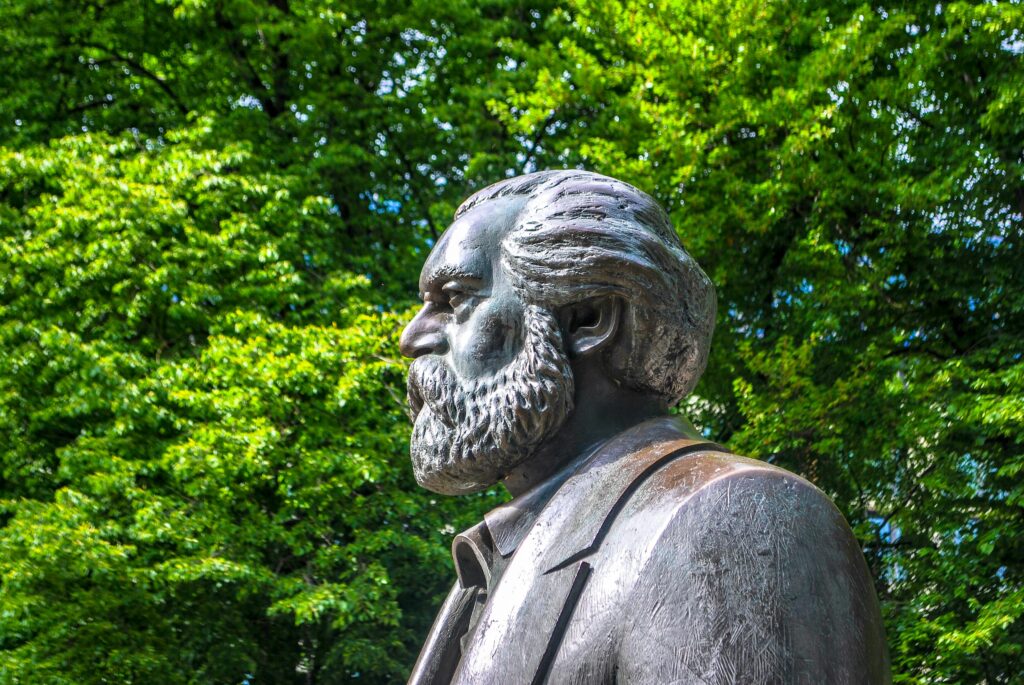
Most people associate the labor theory of value with Karl Marx, but he was building on the work of Smith, David Ricardo, and other classical (capitalist) economists. Marx’s Capital, published in 1867, is largely a critique and transformation of this tradition. Here is the core of his argument:
Use-value and exchange-value
Every commodity — any good or service produced for sale in a market — has a use-value: how useful it is for human needs and wants. A bar of soap. A house. A coat. A television. An education. An insurance policy. Commodities must be useful to someone, or they would not be exchanged.
In the market, commodities also have an exchange-value: how their value compares to other commodities. Money serves as the universal equivalent — a special commodity that measures and mediates exchange, eliminating the need to barter.
What determines exchange value at its core is not usefulness but what Marx calls the “socially necessary labor time” required to produce a commodity under normal conditions with average skill and technology. Machines, tools, animals, and raw materials may contribute to production, but they only transfer the value already embodied in them. They do not create new value.
And yet, those who labor almost never receive the full value of what they produce. Workers are paid wages for their labor, but in the work day they typically produce more value than the value of those wages. The difference is surplus value, appropriated by the owners of capital. This is not a matter of who works harder. This is the system’s structure.
Modern examples
Consider Amazon: warehouse workers and drivers generate enormous value through their labor, but the gap between that value and their wages accumulates at the top. Does Jeff Bezos work millions of times harder than the average employee?
Consider Apple: globally dispersed labor produces devices whose prices far exceed the wages paid along the supply chain, with the surplus realized in profits and shareholder returns.
Consider Black Rock: global surplus value is appropriated through fees, interest, and returns. It owns stock in 95% of Fortune 500 companies. It does not produce value, but rather controls and circulates value created by labor elsewhere.
Follow the surplus
Why does America have fewer than 5% of the world’s population but more than 20% of its incarcerated population? Systems of coercion and control have long helped secure cheap and disciplined labor, making the extraction of surplus more reliable for the ruling class.
The surplus flows upward. When that flow is threatened, there is pressure through policy, lobbying, legislation, and ideology to restore it, whether through cuts to public goods and services, attacks on unions, or the expansion of low-wage labor pools at home and abroad.
The surplus is the terrain of the class struggle. Without labor, the system does not run; without the extraction of surplus value, it does not reproduce itself.
Thank you for reading

This article is part of Issue No. 01 of Garden State Socialist, a publication of the North New Jersey chapter of the Democratic Socialists of America (NNJ DSA).
DSA is the largest socialist organization in the United States, with over 100,000 members and chapters in all 50 states. We believe that working people should run both the economy and society democratically to meet human needs, not to make profits for a few.
We are a political and activist organization, not a party; our members use a variety of tactics, from legislative to direct action, to fight for reforms that empower working people.
Join us! dsausa.org/join
Learn more about NNJ DSA
Take action at our upcoming events